General Crook And Counterinsurgency Warfare by LTC William L. Greenberg
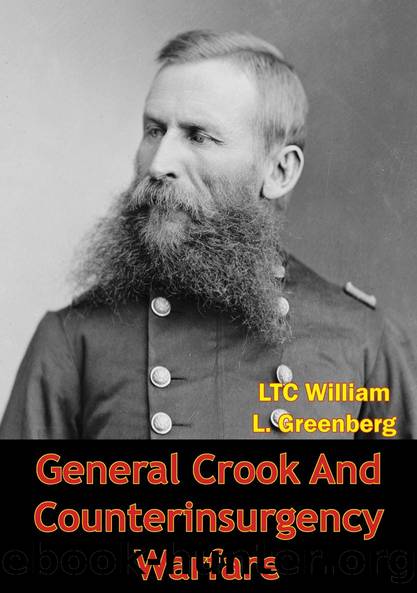
Author:LTC William L. Greenberg [Greenberg, LTC William L.]
Language: eng
Format: epub
ISBN: 9781786253392
Barnesnoble:
Publisher: Normanby Press
Published: 2015-11-06T00:00:00+00:00
CHAPTER 5âGENERAL CROOKâS PARTICIPATION IN THE GERONIMO CAMPAIGN
General Crookâs last active campaign was also his most famous. The operations against the Apaches conducted from 1882 to 1886, usually called the âGeronimo Campaign,â were some of the most famous of all Indian campaigns in American history. It was one of the final chapters in the closing of the western frontier. The campaign has been romanticized in film and print, with the name of Geronimo being immortalized in American lore. Crookâs operational and tactical expertise was crucial in the successful conclusion of the campaign. Ironically, Crook was not a participant in the campaign when it was completed in 1886.
General Crook was recalled to command the Department of Arizona on the fourth of September 1882.{82} Since his departure from the Department of Arizona in 1875, the situation in the southwest had deteriorated rapidly under his successors Brigadier General August Krautz and Major General Orlando Willcox. In 1877 the reservations had again been turned over to the Department of Interiorâs Indian Bureau. The majority of Chirichauas and Warm Spring Apaches had been concentrated in the reservation at San Carlos under the leadership of the civilian agent John Clum. The overcrowding on the San Carlos reservation and the vacillation within the government over the policy towards the Apache caused unrest among the Apache inhabitants. The government policy towards the Apache centered on concentration of the majority of Apaches on a smaller number of reservations, usually in hospitable areas. Further the Apache were not provided with the means to become self-sustaining, forcing the Apaches to become wards of the state. This bleak situation ultimately caused a major breakout of three hundred and ten Warm Spring Apaches, under the leadership of Victorio in September 1877 from the San Carlos reservation. Victorio led the insurgents east to the Department of New Mexico in the vicinity of Fort Wingate, where he and his followers killed a number of ranchers and generally caused havoc throughout the territory. Victorio and his band continued to harass the white settlers until finally Victorio and his group were forced to surrender to pursuing Army columns in the vicinity of Hot Springs, New Mexico. on 8 October 1878.{83}
Victorio and his band did not remain prisoners for long. As the escorting soldiers were moving the band back to San Carlos, Victorioâs band broke free and fled south into Mexico. While in Mexico, Victorio was joined by a number of renegade Chiricahua and Mescalero Apaches. It took another two years of campaigning by U.S. forces to force Victorioâs renegades back onto the reservation. However, Victorio himself never returned to the reservation, because he was killed by the Mexican Tarahumari scout Mauricio on 14 October 1880 in the Mexican State of Chihuahua.{84}
With the death of Victoria, the inhabitants of the southwest thought that a period of peace had ensued. The peace was short-lived due to the advent of a religious revival movement that swept through the Apaches reservations. In 1881 a White Mountain medicine man named Nakaidoklini preached
Download
This site does not store any files on its server. We only index and link to content provided by other sites. Please contact the content providers to delete copyright contents if any and email us, we'll remove relevant links or contents immediately.
Cecilia; Or, Memoirs of an Heiress — Volume 1 by Fanny Burney(32558)
The Great Music City by Andrea Baker(32019)
Cecilia; Or, Memoirs of an Heiress — Volume 2 by Fanny Burney(31956)
Cecilia; Or, Memoirs of an Heiress — Volume 3 by Fanny Burney(31942)
We're Going to Need More Wine by Gabrielle Union(19046)
All the Missing Girls by Megan Miranda(16028)
Pimp by Iceberg Slim(14507)
For the Love of Europe by Rick Steves(14121)
Bombshells: Glamour Girls of a Lifetime by Sullivan Steve(14075)
Talking to Strangers by Malcolm Gladwell(13370)
Norse Mythology by Gaiman Neil(13365)
Fifty Shades Freed by E L James(13241)
Mindhunter: Inside the FBI's Elite Serial Crime Unit by John E. Douglas & Mark Olshaker(9343)
Crazy Rich Asians by Kevin Kwan(9292)
The Lost Art of Listening by Michael P. Nichols(7506)
Enlightenment Now: The Case for Reason, Science, Humanism, and Progress by Steven Pinker(7313)
The Four Agreements by Don Miguel Ruiz(6765)
Bad Blood by John Carreyrou(6621)
Weapons of Math Destruction by Cathy O'Neil(6280)
